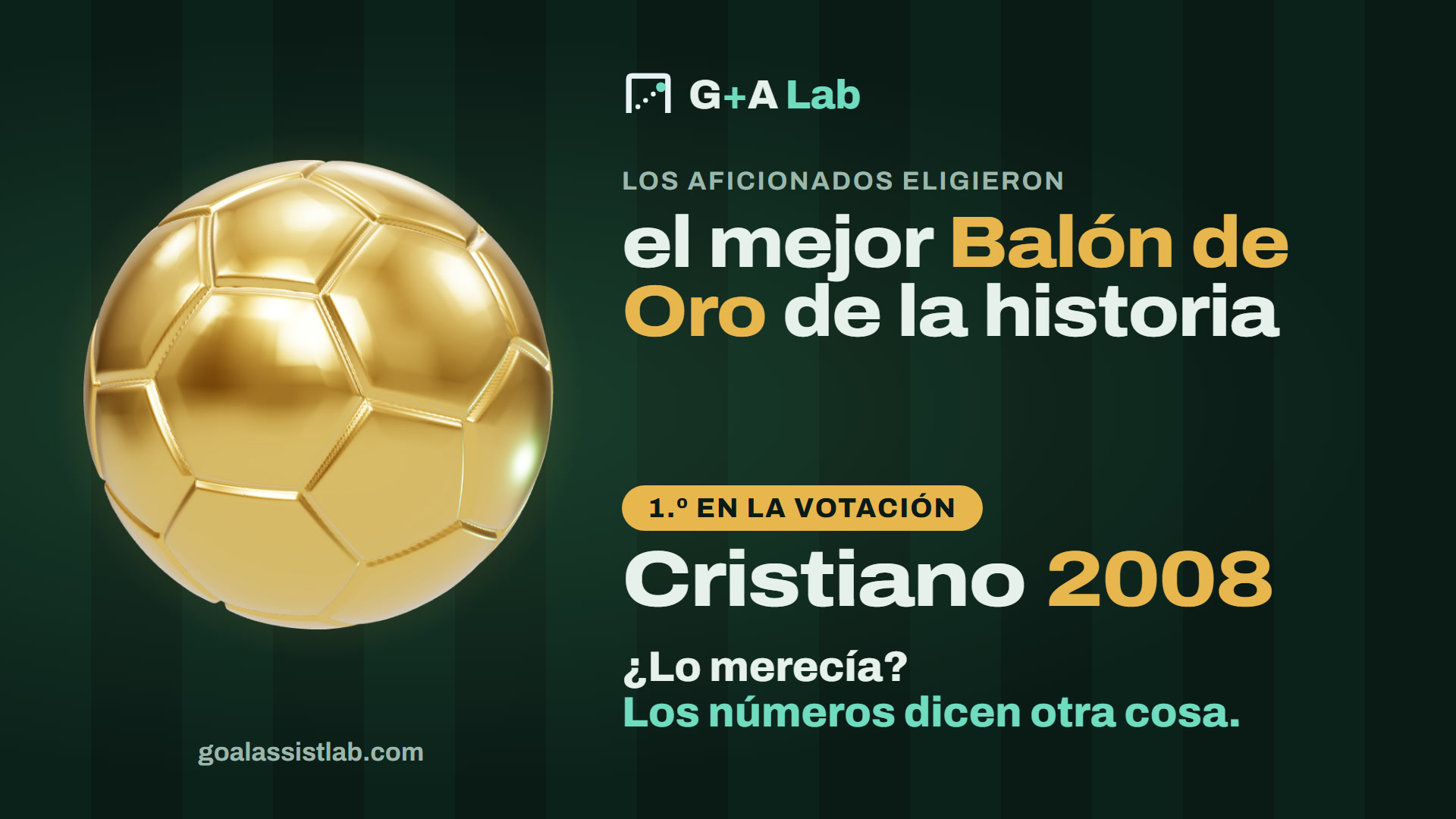
Alongside the 2026 Ballon d’Or, won by Harry Kane, another award was put to a vote: the greatest Ballon d’Or of all time, chosen by fans from among all the winners in history. Cristiano Ronaldo’s first one, from 2008, won. Lionel Messi’s 2012 award came second.
It’s worth clarifying what people were voting for, because it wasn’t the best player in history. Each option was a Ballon d’Or that had already been awarded: Cristiano’s in 2008, Messi’s in 2012, Cruyff’s in 1974, and so on. People chose which of those award-winning seasons was the best.
What stands out most is the rest of the list. The top twelve spots belong to those two. Among the top ten, five each: Cristiano 2008, Messi 2012, Cristiano 2017, Messi 2023, Cristiano 2016, Cristiano 2014, Messi 2015, Cristiano 2013, Messi 2011 and Messi 2009. The first player who is neither of them is Ronaldo Nazário, 13th for his 2002 Ballon d’Or. Cruyff, Platini and Van Basten finished even further down.
One important detail: it wasn’t one vote per person. Each vote cost one euro, and people could vote as many times as they wanted. 5,009 people voted more than once: 4,665 voted between two and four times, 300 between five and nine times, and 44 between ten and twenty-six times. That doesn’t change the figures in this article, but it’s worth keeping in mind when reading the result.
The ten seasons, in goals and assists
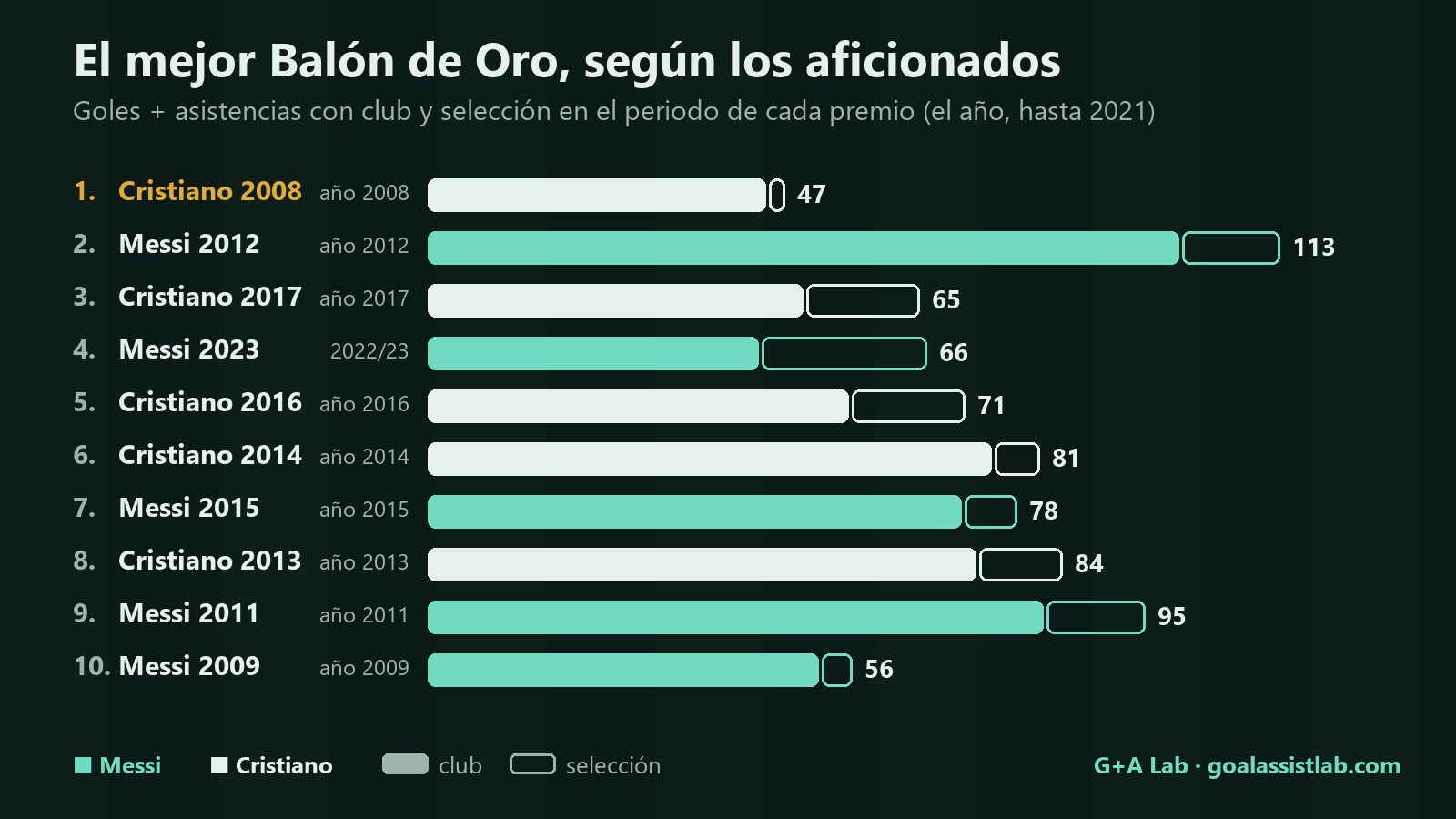
Each Ballon d’Or judges a period: through 2021, the calendar year, from January to December; from 2022 onward, the season, from August to July. We count what each player did during that period for club and country, in all official matches and national-team friendlies.
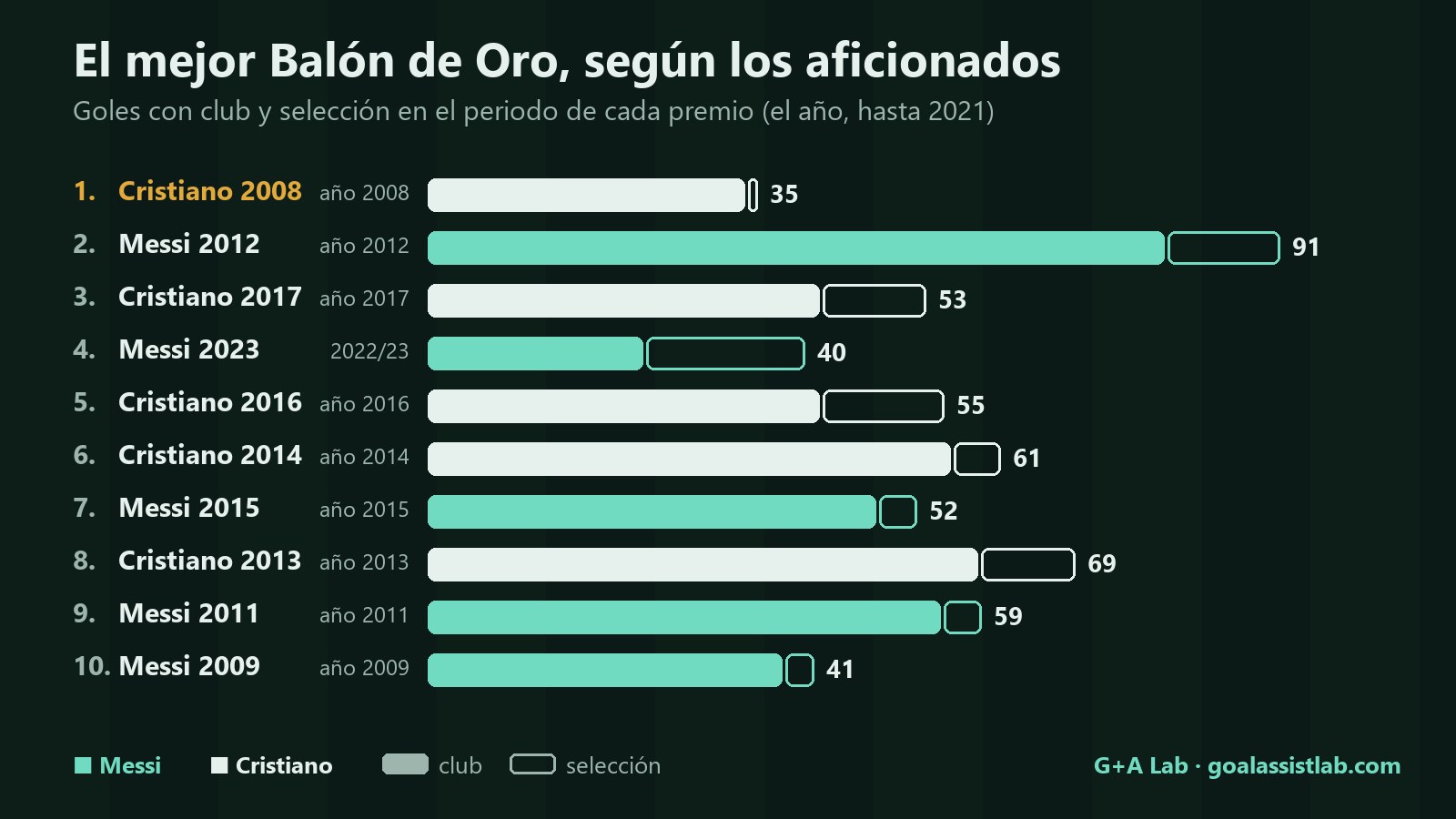
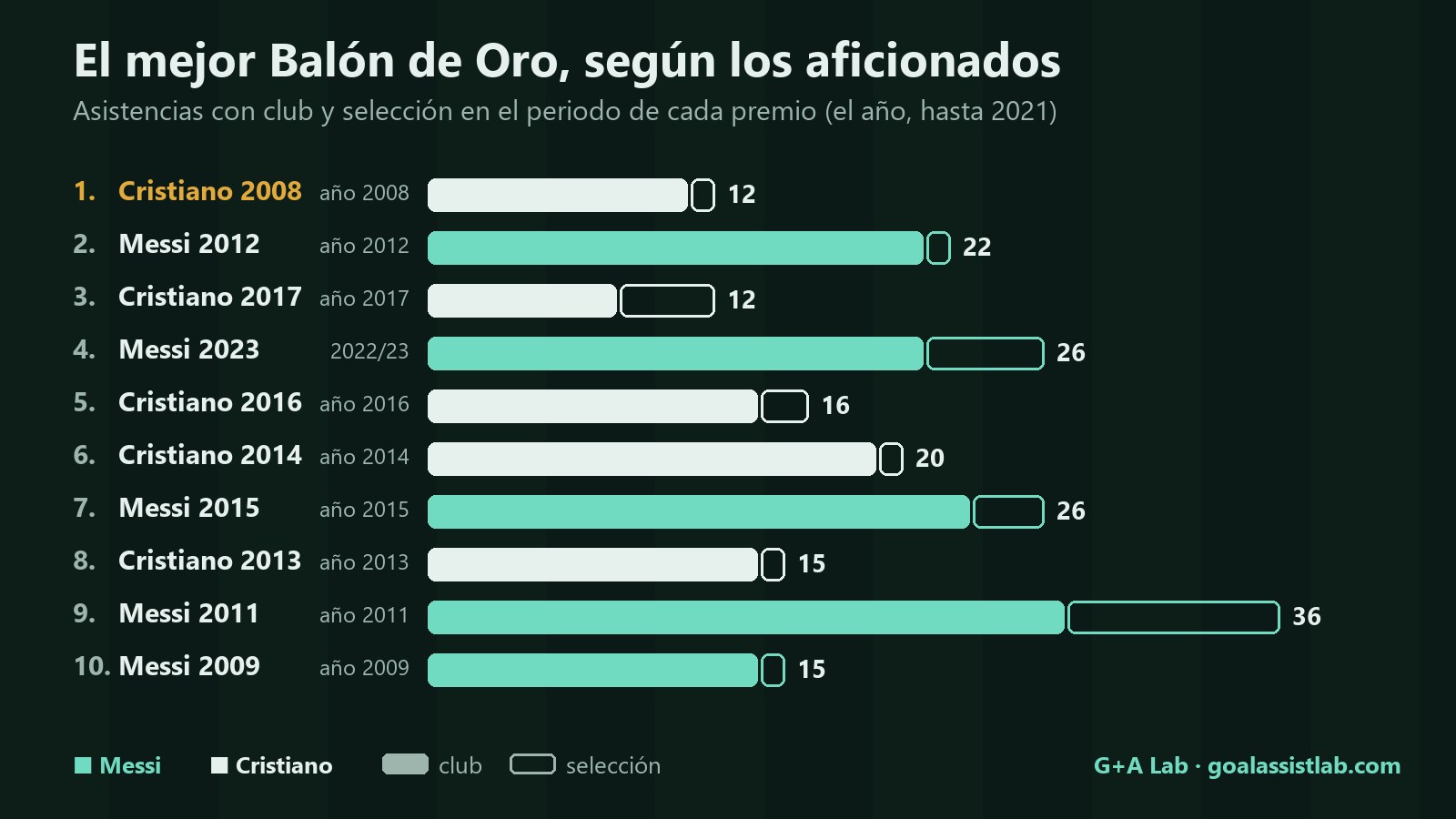
Messi 2012: 91 goals and 22 assists in 69 matches. Messi 2011: 59 goals and 36 assists. Cristiano 2013: 69 goals and 15 assists. Cristiano 2014: 61 goals and 20 assists. Messi 2015: 52 goals and 26 assists.
Cristiano 2016: 55 goals and 16 assists. Messi 2023, the year of the Qatar World Cup: 40 goals and 26 assists. Cristiano 2017: 53 goals and 12 assists. Messi 2009: 41 goals and 15 assists. Cristiano 2008: 35 goals and 12 assists in 58 matches.
Messi’s 91 goals in 2012, 79 for Barcelona and 12 for Argentina, are still the record for goals in a calendar year.
Adding goals and assists, the Ballon d’Or that won the vote is last among the ten: 47, against 113 for Messi in 2012. It’s also last in goals, and tied for last in assists with Cristiano in 2017.
So why did he win?
Because that season can’t be measured in numbers alone. In 2007/08 Cristiano won the Premier League and the Champions League with Manchester United, finished as the Premier League’s top scorer with 31 goals, and scored in the Moscow final. It was his first Ballon d’Or, the year he stopped being a promise and became the best in the world.
There’s another curious detail. Cristiano’s best season by the numbers isn’t on the list: in 2014/15 he scored 61 goals and provided 21 assists for Real Madrid, and Messi won the Ballon d’Or that year.
What the goals don’t tell you
Here’s something to Cristiano’s credit in 2008: he played as a winger, not a centre-forward. His job was to beat defenders down the flank, and a lot of that doesn’t end in a goal or an assist. What we do know is how often he got into shooting positions: in the 2007/08 Premier League, he had 179 shots, 65 more than the runner-up, Steven Gerrard. Nobody in England shot that often.
Messi had the edge in dribbling, though: that season, between La Liga and the Champions League, he completed 168 dribbles to Cristiano’s 126. And the gap grew in the following years. In the 2011/12 season, the year of the 2012 Ballon d’Or, Messi made 125 key passes and 71 through balls; Cristiano made 84 and 22. In 2014/15, the season of the treble, Messi completed 266 dribbles and created 48 big chances; Cristiano had 79 and 21. There are no public records of key passes or chances created for 2007/08, so the comparison across the ten seasons comes down to goals, assists, trophies and shots, which can be counted for every season.
Messi 2012 has one weak point; 2011 and 2015 don’t
You can hold one thing against Messi in 2012: despite all 91 goals, he won only the Copa del Rey that year. Barcelona lost La Liga and the Spanish Super Cup to Cristiano’s Real Madrid, and went out of the Champions League in the semifinals against Chelsea. For many people, that counts for more than any number.
The clearest example is the 2011 Ballon d’Or. That year Messi won La Liga and the Champions League, the same two major trophies Cristiano won in 2008, plus the Spanish Super Cup, the UEFA Super Cup and the Club World Cup: five trophies. He scored in the Wembley final, against Manchester United of all teams, and finished with 59 goals and 36 assists in 70 matches, compared with Cristiano’s 35 goals and 12 assists in 2008. It’s the second-best total of the ten, after his own 2012. He finished ninth in the vote.
2015 is similar: that year he won the treble with Barcelona (La Liga, the Copa del Rey and the Champions League), plus the UEFA Super Cup and the Club World Cup, with 52 goals and 26 assists. He finished seventh.
What if we count the titles?
The obvious objection is that numbers aren’t everything: titles count too. So we counted them. The problem is deciding how much each one is worth, because there’s no official table saying how much a Champions League title is worth compared with a Super Cup. So we made our own, out in the open: the World Cup is worth 8 points; the Champions League, the European Championship and the Copa América, 6; a league title from one of the five major leagues, 4; a domestic cup or the Club World Cup, 2; a super cup, 1.
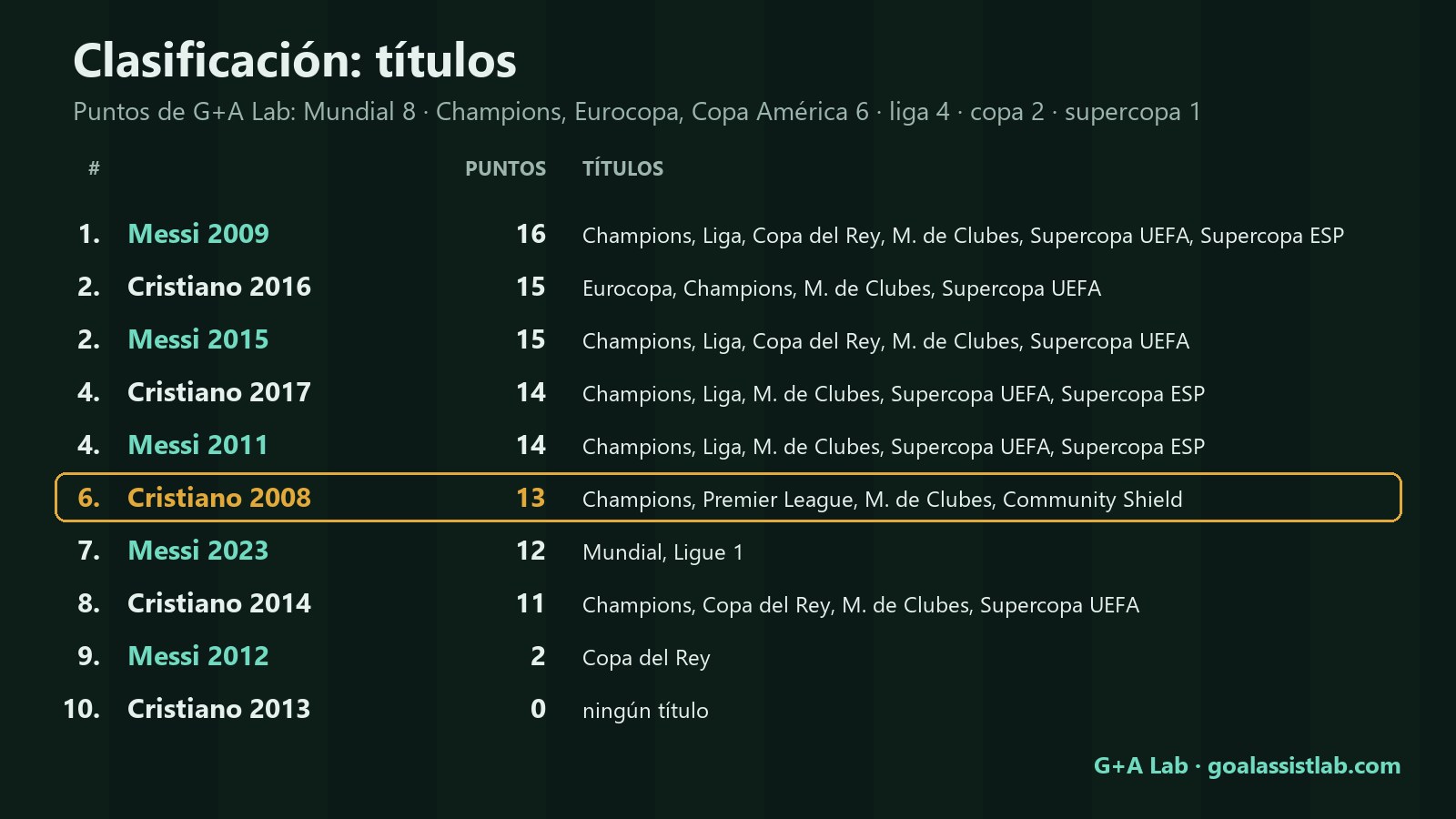
With this scale, Cristiano 2008 comes sixth with 13 points: the Champions League, the Premier League, the Club World Cup and the Community Shield. At the top is Messi 2009, the one with the sextuple, on 16. Messi 2012’s weak spot is clear: just 2 points. And the most curious case is Cristiano 2013: third in goals and assists, with no titles at all.
To bring the two together, we don’t add goals to points. We average each season’s place in the two tables, so that numbers and titles carry the same weight.
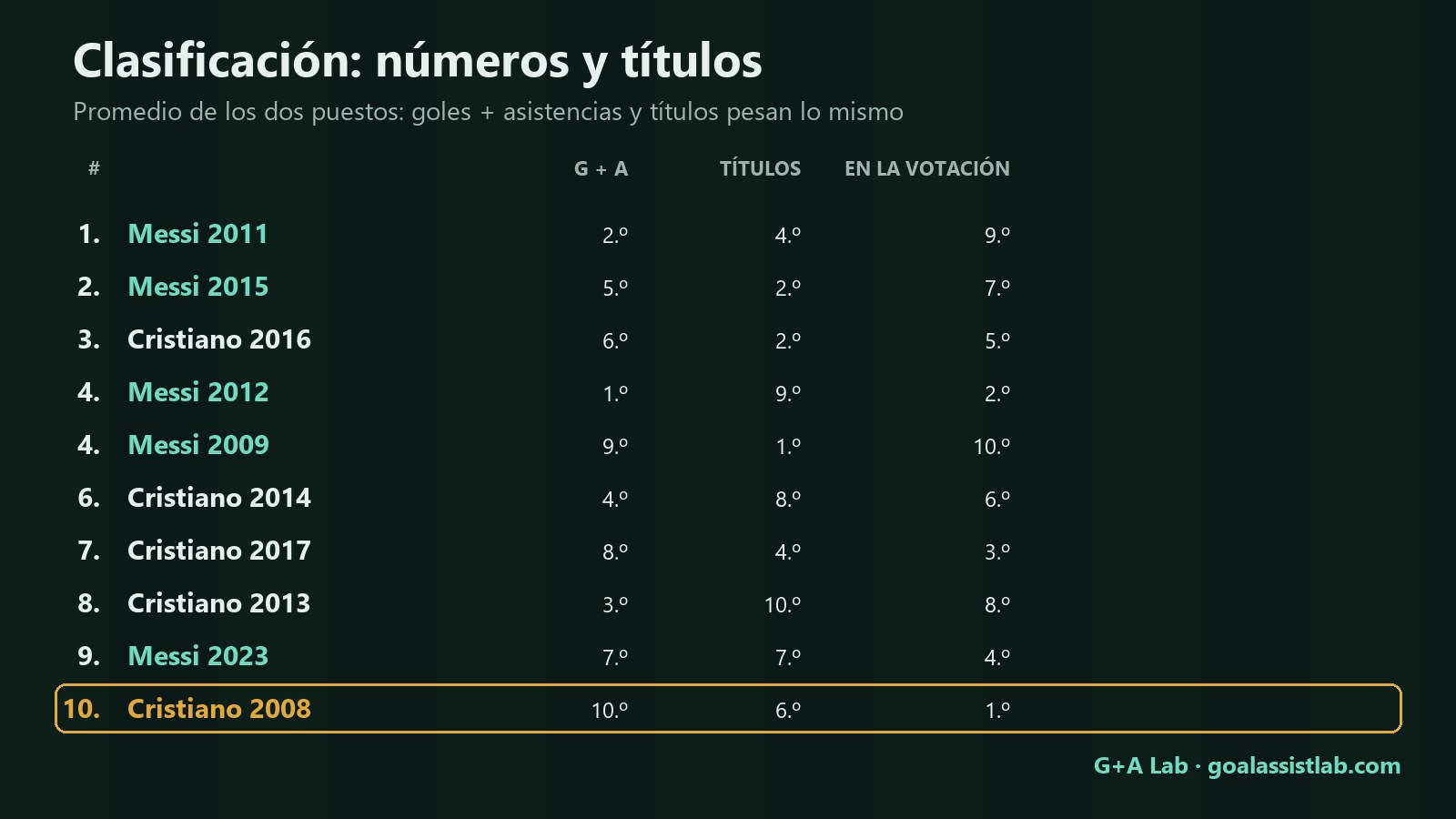
First is Messi 2011, second in numbers and fourth in titles. Next come Messi 2015 and Cristiano 2016, the best Cristiano on the list. And the Ballon d’Or winner in the fan vote finishes last here too: tenth in numbers and sixth in titles.
The scale is our decision, and people can disagree with it. We’re making it public so everyone can come up with their own.
On the goals and assists chart
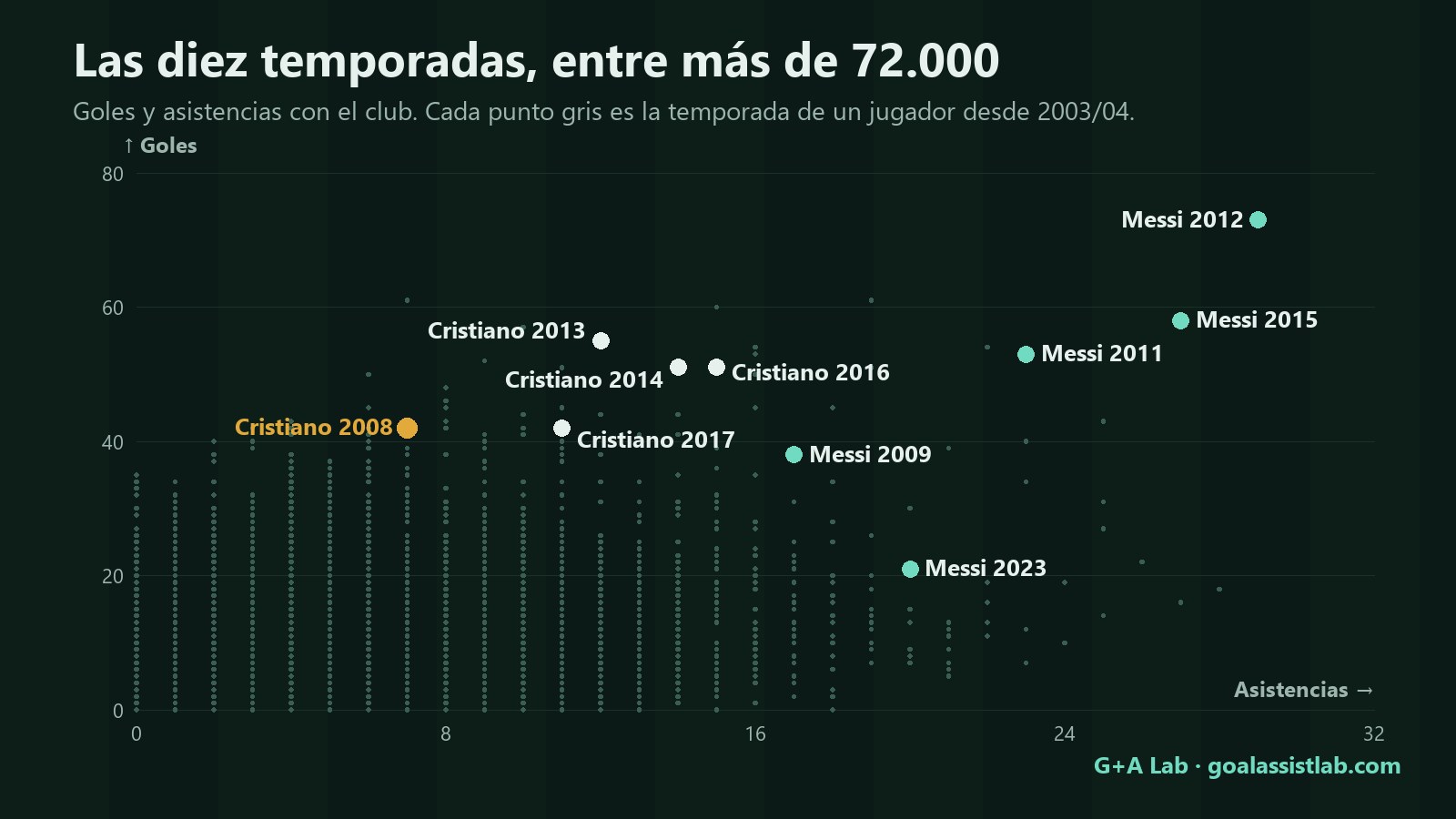
Put the ten seasons on a goals-and-assists chart alongside every club season since 2003/04, and the difference jumps out. This chart counts only matches for the club, by season, so they can be compared with every other club season. Cristiano in 2008 sits to the left: lots of goals, few assists. Up in the top right, where the players who do both sit, only Messi’s seasons appear.
And it shows something else: Cristiano’s best season wasn’t 2008 either. His next four Ballon d’Or wins, from 2013 to 2017, all sit to the right of that point, with more assists and just as many or more goals. In other words, the season fans chose as the best ever isn’t even Cristiano’s own best.
Since 2003/04, only four club seasons have reached 45 goals and 20 assists. Three belong to Messi: 2010/11, 2011/12 and 2014/15—in other words, his 2011, 2012 and 2015 Ballon d’Or seasons. The fourth belongs to Luis Suárez in 2015/16.
The bell curve: Cristiano in 2008 vs. Cristiano in 2012
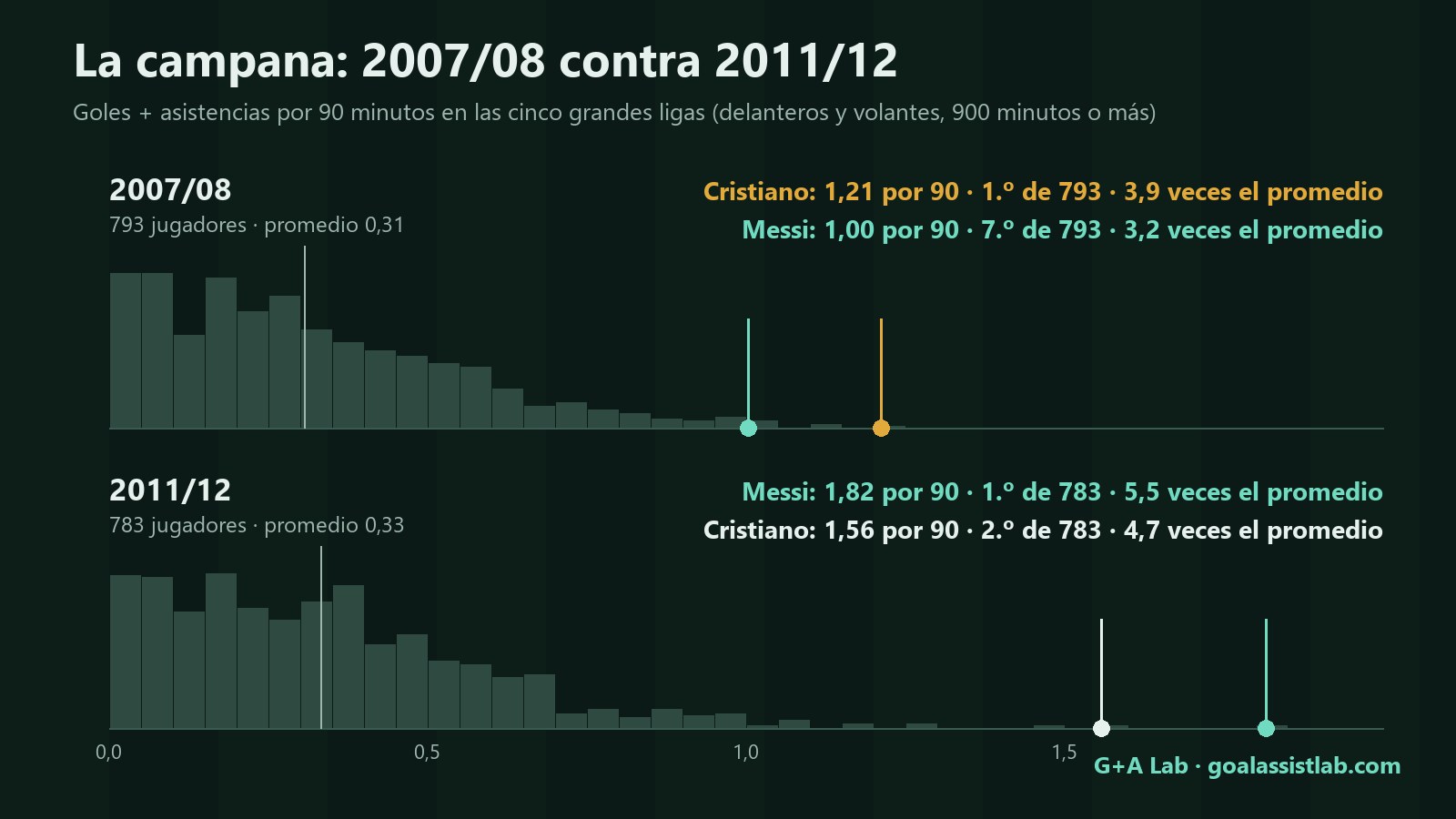
Another way to look at it is the bell curve: where each player stands compared with everyone else in his season. Here we count goals and assists per 90 minutes in league play across the five major leagues, for forwards and midfielders who played at least 900 minutes.
In 2007/08, Cristiano ranked first among 793 players, with 1.21 per 90 minutes: almost four times the average. But he wasn’t alone. Ibrahimović, Eto’o, Villa and Mario Gómez were close behind.
What’s interesting is what happened four years later. In 2011/12, Cristiano scored 46 goals and provided 12 assists in La Liga, won it with Real Madrid and reached 1.56 per 90 minutes, well above his 2008 mark. And that year he didn’t win the Ballon d’Or, because Messi was even further ahead: 1.82, alone at the top of the bell curve.
Put another way: the Cristiano fans chose as the greatest Ballon d’Or winner of all time was outdone by Cristiano himself, in a year when he didn’t even win it.
The numbers versus the memory
The vote rewarded memory more than numbers. If the question is which season had the best stats, the answer is Messi 2011, 2012 or 2015. But football is passion and nostalgia, and people vote for the season that made them believe in a player. For many, that was Cristiano’s time in Manchester. That’s exactly why Cristiano is the GOAT, the greatest of all time, for many fans—and they showed it with this award.
How we measured it: goals and assists counted match by match, for club and country (including friendlies), over the period each award covered: the calendar year through 2021, and August to July from 2022 onward. The scatter plot includes only club matches, by season. Trophies: those each player won over the same period, using G+A Lab’s points scale explained in the article. Shots come from ESPN match reports. Dribbles, key passes, through balls and big chances cover La Liga and the Champions League and come from WhoScored (Opta data): key passes and through balls are available from 2009/10, big chances from 2010/11, and only dribbles for earlier seasons. The bell curve includes only league matches in the top five leagues, as in G+A Lab’s version. The fan vote and its ranking come from TNT Sports and Football360; the vote price and repeated votes come from Marca (with data from France Football) and Goal (October 29, 2026).